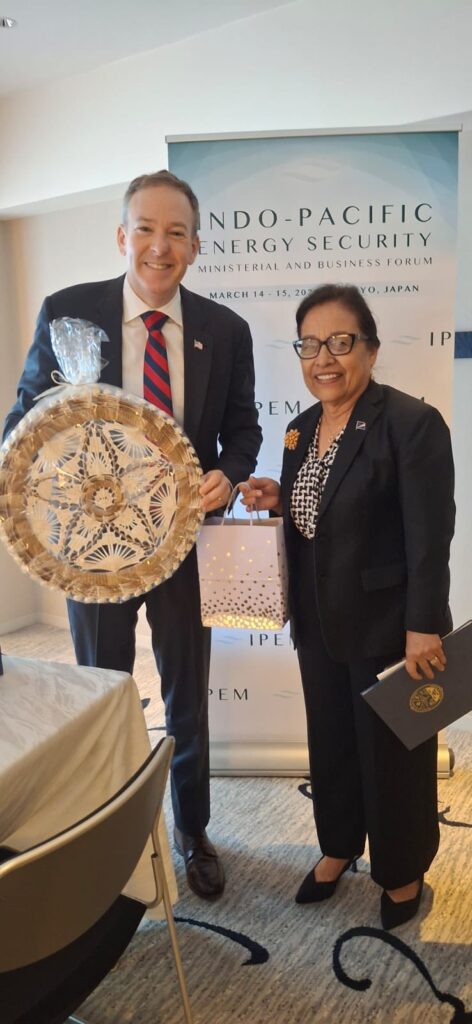
TOKYO, JAPAN — March 15, 2026 — Her Excellency Hilda C. Heine met with Lee Zeldin, Administrator of the United States Environmental Protection Agency on the margins of the Indo-Pacific Energy Security Ministerial and Business Forum (IPEM) in Tokyo, Japan.
The meeting reaffirmed the strong and enduring environmental partnership between the Republic of the Marshall Islands and the United States, with particular emphasis on strengthening RMI EPA and US EPA Region 9 cooperation to fulfill joint oversight responsibilities to ensure that RMI’s environmental standards are substantially equivalent to those of the United States. President Heine underscored the importance of the FAS Circuit Rider Program noting that the Program’s early implementation made a great difference and enhanced RMI EPA’s capacity to monitor, assess, and safeguard the environment and public health. President Heine encouraged an expansion of the program ‘if US EPA can double or triple the funding’ as it will help strengthen RMI EPA protect the country’s natural resources and environment while also engaging with the Appropriate Agencies including U.S. Environmental Protection Agency, the U.S. Fish and Wildlife Service, the National Marine Fisheries Service, and the U.S. Army Corps of Engineers to ensure that all activities at USAG-KA conform to the established environmental standards (UES). The RMI looks forward to having the Circuit Rider reinstated to see this positive cooperation continue.
Discussions also highlighted the RMI’s commitment to advancing transformative environmental initiatives under the new Compact of Free Association. President Heine emphasized that robust U.S. EPA partnership and practical technical assistance will be critical to achieving these goals. “We may be eligible for certain US EPA grants, but the red tape is confusing for a small island government like ours.”
President Heine expressed appreciation for the continued partnership between the two countries and welcomed further collaboration to address environmental priorities and resilience in the Pacific.